
Posted on Leave a comment

Peptide Purity Testing: The Complete Analytical Toolkit (HPLC, MS, Gravimetric, GC-MS)

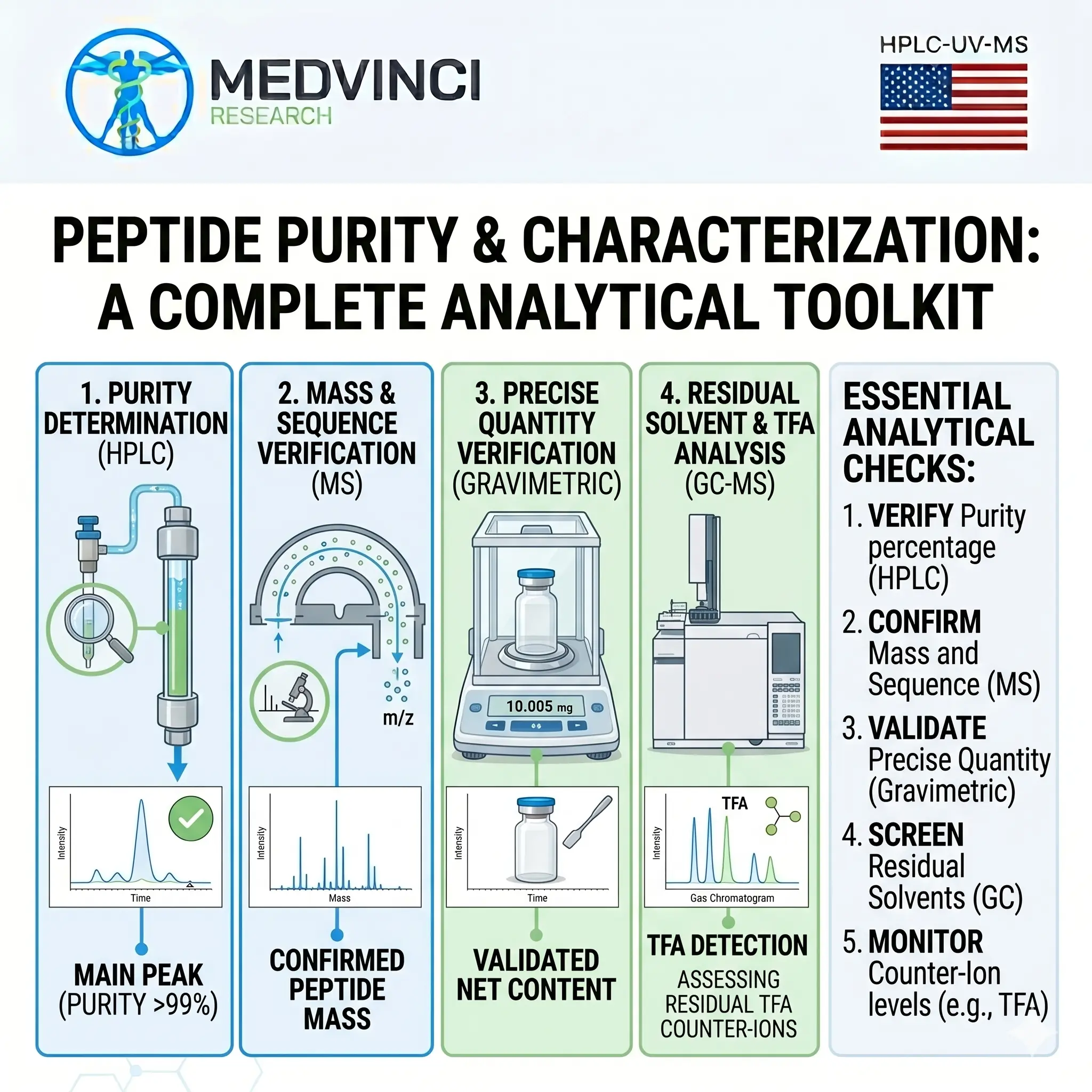
Peptide purity testing infographic showing the four-test analytical toolkit — HPLC purity determination, mass spectrometry sequence verification, gravimetric net content, and GC-MS residual solvent and TFA analysis — plus 5 essential analytical checks (Medvinci Research)

If your peptide supplier hands you a single number — “98% purity” — and calls it a day, you’re working with about a quarter of the picture.

Peptide quality is not one measurement. It’s a four-axis problem: how pure is it, what’s actually in it, how much is in the vial, and what came along for the ride from the synthesis lab. Skip any axis and you’re either dosing wrong, dosing the wrong molecule, or dosing the right molecule alongside a counter-ion that’s quietly skewing your results.

Here’s the analytical toolkit a serious peptide purity testing program should include — and how to read each piece without an analytical chemistry degree.

The four-test toolkit at a glance

  • HPLC — purity (% target peptide vs. peptide-related impurities).
  • Mass spectrometry — identity (is this actually the sequence you ordered?).
  • Gravimetric assay — quantity (how many milligrams of peptide are really in the vial?).
  • GC-MS — what came with it (residual solvents and counter-ion content).

Why peptide purity actually matters

Two reasons.

Reproducibility. If your peptide is 92% target and 8% deletion sequences, the second batch is unlikely to behave like the first. The impurity profile drifts lot-to-lot, and so does whatever biological signal you’re trying to measure.

Dosing accuracy. A 10 mg vial that’s 85% net peptide content — after subtracting water, salts, and counter-ions — is an 8.5 mg vial. If your protocol calls for 10 mg, you’re under-dosing by 15%. That’s the difference between a clean dose-response curve and a noisy one you can’t explain.

The four tests below address these problems from different angles. You want all four.

Test 1: HPLC — Purity Determination

What it measures: The percentage of the target peptide relative to all other peptide-related species in the sample.

How it works: High-Performance Liquid Chromatography (HPLC) separates the mixture by pushing it through a column that retains different molecules for different durations. UV detection — typically at 214 nm for the peptide bond, or 280 nm for aromatic residues — produces a chromatogram where the area under each peak represents the relative abundance of each species.

What “good” looks like: A single dominant peak integrating to ≥98% of total peak area. Research-grade peptides commonly target ≥95%; pharmaceutical-grade targets ≥99%.

Watch the wavelength

Suppliers reporting purity without specifying the wavelength, gradient, or detection method are skipping the part that matters. 98% pure at 254 nm is not the same as 98% at 214 nm. The 214 nm number is the honest one for peptides because almost every amino acid absorbs there. Higher wavelengths only see aromatic residues and quietly hide everything else.

Test 2: Mass Spectrometry — Mass & Sequence Verification

What it measures: The molecular mass of the peptide, which confirms you actually got the sequence you ordered.

How it works: Mass spectrometry (usually ESI-MS or MALDI-TOF for peptides) ionizes the molecule and measures its mass-to-charge ratio (m/z). The observed mass should match the theoretical monoisotopic or average mass calculated from the sequence — typically within 0.1 Da on a high-resolution instrument.

Why it matters: HPLC tells you the sample is pure. Mass spec tells you what it’s pure of. You can have a 99% pure sample of the wrong peptide. This happens more than the industry likes to admit, particularly with sequences that differ by a single amino acid substitution or a missing residue near the N-terminus.

Common mistake

A COA that shows HPLC but no MS spectrum is half a quality story dressed up as a whole one. Identity is not optional.

Test 3: Gravimetric Analysis — Precise Quantity Verification

What it measures: The actual mass of material in the vial, verified against the label.

How it works: Analytical balances accurate to 0.01 mg confirm net content. This is the least glamorous test on the list and the one most likely to bite you.

Why it matters: Lyophilized peptides almost always contain residual water, counter-ions (TFA or acetate), and trace salts. A vial labeled “10 mg peptide” may contain 10 mg of material, of which only 8.2 mg is actual peptide. Without a peptide content assay — sometimes called net peptide content or peptide assay by amino acid analysis (AAA) — you don’t know your real concentration.

Watch for the gross-vs-net distinction. Premium suppliers report both gross mass and net peptide content. Most report neither and let you assume.

Test 4: GC-MS — Residual Solvents & TFA Analysis

What it measures: Trace solvents left over from synthesis and counter-ion content — notably trifluoroacetic acid (TFA).

How it works: Gas Chromatography coupled with Mass Spectrometry (GC-MS) separates and identifies volatile compounds. For peptides, the targets are residual solvents (DMF, DCM, acetonitrile, methanol, isopropanol) and TFA, which is the default counter-ion left behind from reverse-phase HPLC purification.

Why TFA matters: TFA can account for 5–20% of the mass of a lyophilized peptide. It’s not biologically inert — it has documented effects on mitochondrial function and can confound results in sensitive in-vitro systems. For applications where TFA interference is a concern, peptides should be exchanged into acetate or HCl salts, and the new counter-ion content reverified.

Why residual solvents matter: Synthesis and purification solvents have ICH Q3C limits for a reason. Class 2 solvents like DCM and DMF are not what you want in a cell-culture experiment. For the regulatory context behind these limits, see our companion guide on the 2026 peptide regulatory framework.

The most common COA gap

COAs that omit residual solvent and counter-ion data entirely are the single most common gap in commercial peptide documentation. If you don’t see GC-MS, ask why.

The 5-point checklist for evaluating any peptide COA

Before you trust a vial, the certificate of analysis should clear all five:

  1. Verify purity percentage by HPLC — with method conditions stated (column, gradient, detection wavelength).
  2. Confirm mass and sequence by MS — with observed vs. theoretical mass shown.
  3. Validate precise quantity gravimetrically, ideally with both gross mass and net peptide content.
  4. Screen residual solvents by GC against ICH Q3C limits.
  5. Monitor counter-ion levels (typically TFA), with explicit % w/w reported.

Any COA missing two or more of these is incomplete. Any supplier who can’t answer follow-up questions about their analytical methods is selling you a number, not a measurement. For a deeper read on what a real peptide COA contains and how to spot the fakes, see How to Read a Peptide COA and Third-Party vs. Vendor-Only COAs.

Why most suppliers skip half of this

The honest answer: full analytical characterization costs money. A complete HPLC + MS + GC-MS + gravimetric workup runs roughly $150–$400 per batch depending on the contract lab. At low margins or high volume, suppliers cut GC-MS first, then the net peptide content assay, then MS, until what’s left is a single HPLC trace and a label.

That math works for the supplier’s P&L. It does not work for the researcher whose data depends on knowing what’s actually in the vial.

What this means for buyers

You don’t need to run the tests yourself. You need to insist on seeing them done.

When evaluating a peptide source, three questions cut through almost any sales pitch:

  • Can you send me a representative COA with HPLC, MS, GC-MS, and net peptide content?
  • What’s your typical TFA % w/w?
  • What detection wavelength is your HPLC purity reported at?

A supplier who answers all three without flinching has built the analytical infrastructure. A supplier who deflects, redirects, or sends a one-page summary with no method details is asking you to take their word for it. Your data is too expensive to make on faith.

Frequently asked questions about peptide purity testing

What’s the difference between peptide purity and peptide content?

Purity is the percentage of target peptide relative to other peptide-related impurities (deletion sequences, oxidized variants, truncations). Content is the percentage of the vial mass that is actually peptide, after subtracting water, salts, and counter-ions. A peptide can be 99% pure and only 80% content — and both numbers can be true on the same COA.

Is 95% purity good enough for research peptides?

For most in-vitro and exploratory animal work, yes — provided the impurity profile is characterized and consistent batch-to-batch. For receptor binding studies, structure-activity work, or anything dose-sensitive, 98%+ is the working standard.

Why is there TFA in my peptide?

TFA is the standard mobile-phase acid used in reverse-phase HPLC purification. It binds to basic residues (Lys, Arg, His) as a counter-ion and is co-lyophilized with the peptide unless explicitly exchanged into a different salt form.

Do I need GC-MS data on every batch?

For routine work with a validated supplier, periodic GC-MS verification is acceptable. For new suppliers, new sequences, or any batch destined for a sensitive assay, request it on the specific lot you’re using.

What does “≥99% by HPLC at 214 nm” actually mean?

It means that when the sample was run on a reversed-phase HPLC column and detected at 214 nm (the peptide bond absorbance), the target peak accounted for at least 99% of the total integrated peak area. It does not address non-peptide impurities — salts, solvents, water, counter-ions. That’s what the other three tests are for.

What’s the difference between MALDI-TOF and ESI-MS for peptides?

Both confirm peptide mass. MALDI-TOF is faster and tolerates more sample contamination, making it the workhorse for routine confirmation. ESI-MS gives higher mass accuracy and couples cleanly to LC for impurity identification. For QC release, either is acceptable; for impurity characterization, ESI-MS is the better tool.

How do I know if a COA is real?

Real COAs include: lot number, manufacture date, retest date, the actual chromatograms and spectra (not just summary numbers), method parameters, and a signature or QC release stamp. A one-page table of numbers with no underlying data is a certificate of compliance, not a certificate of analysis. They are not the same document. The Medvinci public COA directory shows what a third-party-verifiable batch record actually looks like.

The bottom line

Peptide purity is a single line on a four-line story. The other three lines — identity, quantity, and what came with it — are where the experimental noise actually lives.

Demand all four. The suppliers who can deliver them will respect you for asking. The ones who can’t have just told you something useful.

Not industry standard. Should be.

Medvinci Research publishes a complete analytical package — HPLC purity, MS mass and sequence verification, gravimetric net content, and GC-MS residual solvent and TFA analysis — with every batch. Browse the public COA directory to see real batch records, or open a research account to track every batch you receive.
Posted on Leave a comment

Peptide COA Verification: Third-Party vs. Vendor-Only COAs

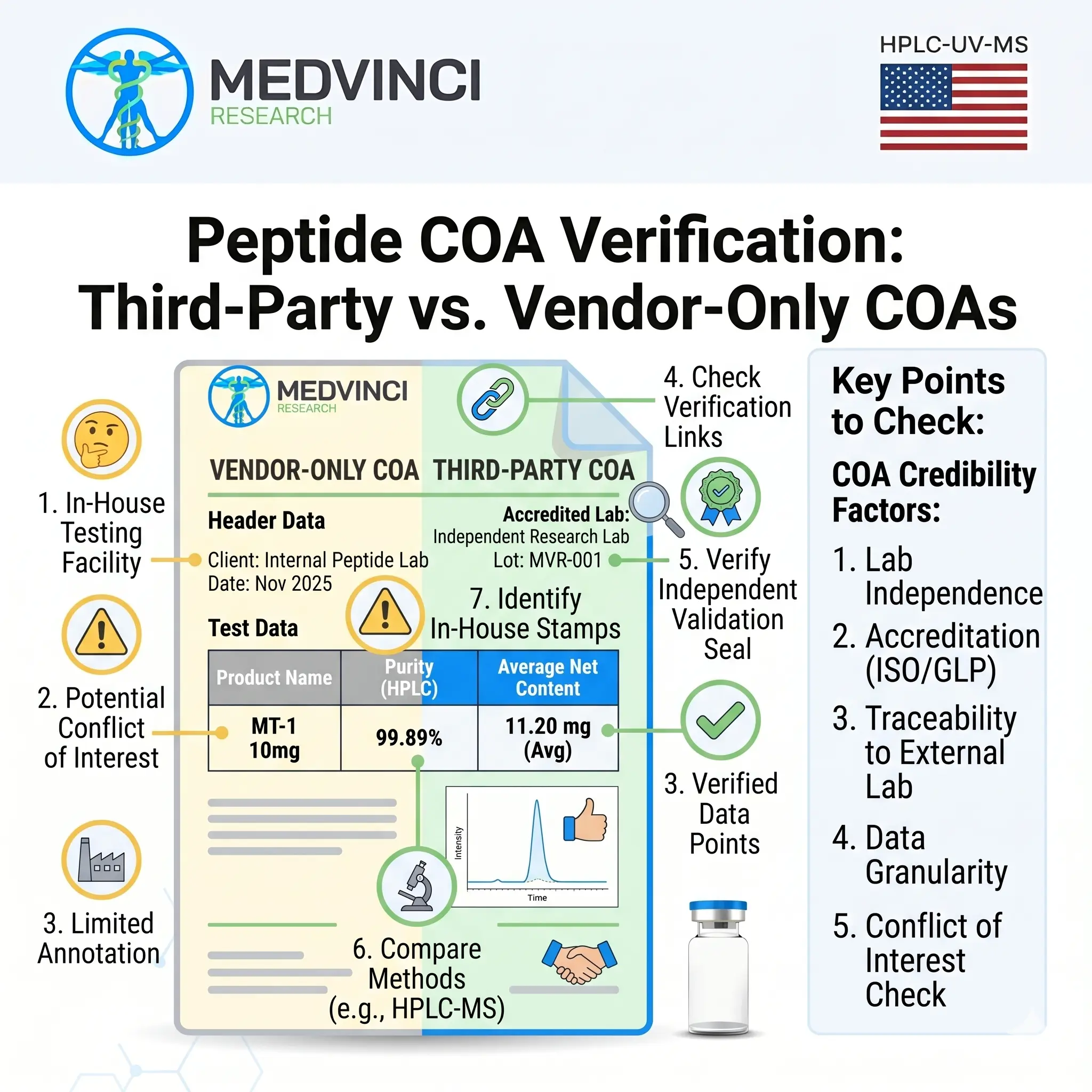
Peptide COA Verification Third-Party vs Vendor-Only COAs

Peptide COA verification is the difference between seeing a purity claim and confirming that the batch behind it is real. The critical question is not whether a seller says a COA exists, but whether you can match the peptide, the accession code, and the outside verification path without relying on a single site.

Fast takeaway

A vendor-only peptide COA can still be useful, but it asks you to trust a single party. A third-party verified peptide COA adds an outside checkpoint, which makes it much harder for the proof chain to break without you noticing.

What peptide COA verification actually means

Peptide COA verification means confirming that the peptide listing, the batch record, and the outside proof chain all point to the same thing. It is not just reading a PDF. It is making sure the peptide, the accession code, and the verification route line up before you trust the result.

That matters because a buyer can be shown a real-looking report that still does not belong to the exact peptide they are considering. Verification is what turns a seller claim into something you can test.

What a vendor-only peptide COA is

A vendor-only peptide COA is a report the seller provides directly, usually as a PDF, image, or embedded document on the product page. That does not automatically mean the report is bad. It means the same business selling the peptide is also controlling the evidence you are being asked to trust.

That setup creates a simple problem: if the report is cropped, outdated, generic, hard to match to a batch, or impossible to verify outside the seller’s site, you have no second checkpoint. You are left evaluating a claim inside the same system that benefits from the sale.

What third-party peptide COA verification adds

Third-party peptide COA verification adds an outside record. Instead of stopping at a seller-hosted document, you can compare the on-site listing to a separate verification page and make sure the peptide name, accession code, and report path still line up.

That extra step matters because it changes the trust model. You are no longer relying on one business to say both this is the batch and trust us, the report is real. You can check the batch against an independent source before you rely on the purity claim.

CheckpointVendor-only COAThird-party verified COA
Where the proof startsOn the seller’s siteOn the seller’s site plus an outside verification record
Who controls what you can seeThe seller controls the full proof chainThe seller publishes the route, but you can verify beyond the seller page
Batch matching confidenceOften weaker if the document is generic or hard to traceStronger when the accession code and outside record match
Best useStarting point for questionsStronger basis for trust before ordering

How peptide purity, quality, and composition fit into the picture

Peptide purity, quality, and composition are important, but they only matter after you know the report belongs to the right batch. Purity tells you how much of the analyzed sample matched the target peptide. Composition helps confirm what the sample contains. Quality is the broader trust question that includes the method, the report path, and whether the batch can be verified beyond the seller page.

That is why verification comes first. If the proof chain is weak, a strong-looking purity number can still mislead the buyer. Verification makes those downstream metrics worth reading.

Do not ask only, “Is there a COA?” Ask, “Can I verify this peptide batch outside the seller’s own page?”

How to verify a Medvinci peptide COA

Medvinci keeps its COAs on the public COA directory. Each listing gives you a peptide name, a COA number, a purity result, and a Verify COA action that points you to the corresponding Freedom Diagnostics verification page.

That matters because the Medvinci card is not meant to be the end of the process. It is the index. The outside verification page is the confirmation step. When the peptide and code match across both, you have a much stronger reason to trust the batch record than you would from a seller-hosted PDF alone.

A fast peptide COA trust test

  • Find the product on the COA directory.
  • Match the peptide name and displayed COA number.
  • Click Verify COA and confirm the Freedom Diagnostics page corresponds to the same batch.
  • Only after that, interpret the purity, quality, composition, and method details.

Red flags in peptide COA verification

  • The seller shows a report image, but there is no live verification path.
  • The peptide name and batch code are hard to match across pages.
  • The report looks polished, but the underlying source is unclear or inaccessible.
  • The purity number is emphasized more than the batch identity or verification route.
  • The outside record does not line up cleanly with the peptide you intended to buy.

Vendor-only does not always mean bad, but it does mean weaker proof

This distinction is worth making clearly. A vendor-only peptide COA is not automatically fake or worthless. It is just easier to trust too quickly because the whole story lives inside the seller’s own presentation layer. If the proof cannot be independently checked, you should treat it as weaker evidence.

Third-party verified peptide COAs are stronger because they reduce how much blind trust is required. That is the real advantage: not marketing language, but a cleaner chain of verification.

FAQ

Is a vendor-only COA automatically a dealbreaker?

No. It is a signal to slow down and ask for a clearer proof chain. The issue is not that every vendor-only report is false. The issue is that you have fewer independent ways to confirm it.

Is third-party verification enough on its own?

It is stronger, but you still need to make sure you are looking at the correct peptide and the correct batch. Verification only helps if the match is clean.

What is the safest way to verify a Medvinci peptide COA?

Start from the COA directory, use the on-site card to identify the peptide and code, then click Verify COA so you land on the matching Freedom Diagnostics page. If you want a deeper walkthrough of reading the report itself, see How to Read a Peptide COA.

Compare a live example yourself

Open the COA directory, choose a peptide, and compare the Medvinci listing to the outside verification page. That one habit will tell you more than any isolated purity badge.

Posted on Leave a comment

How to Read a Peptide COA

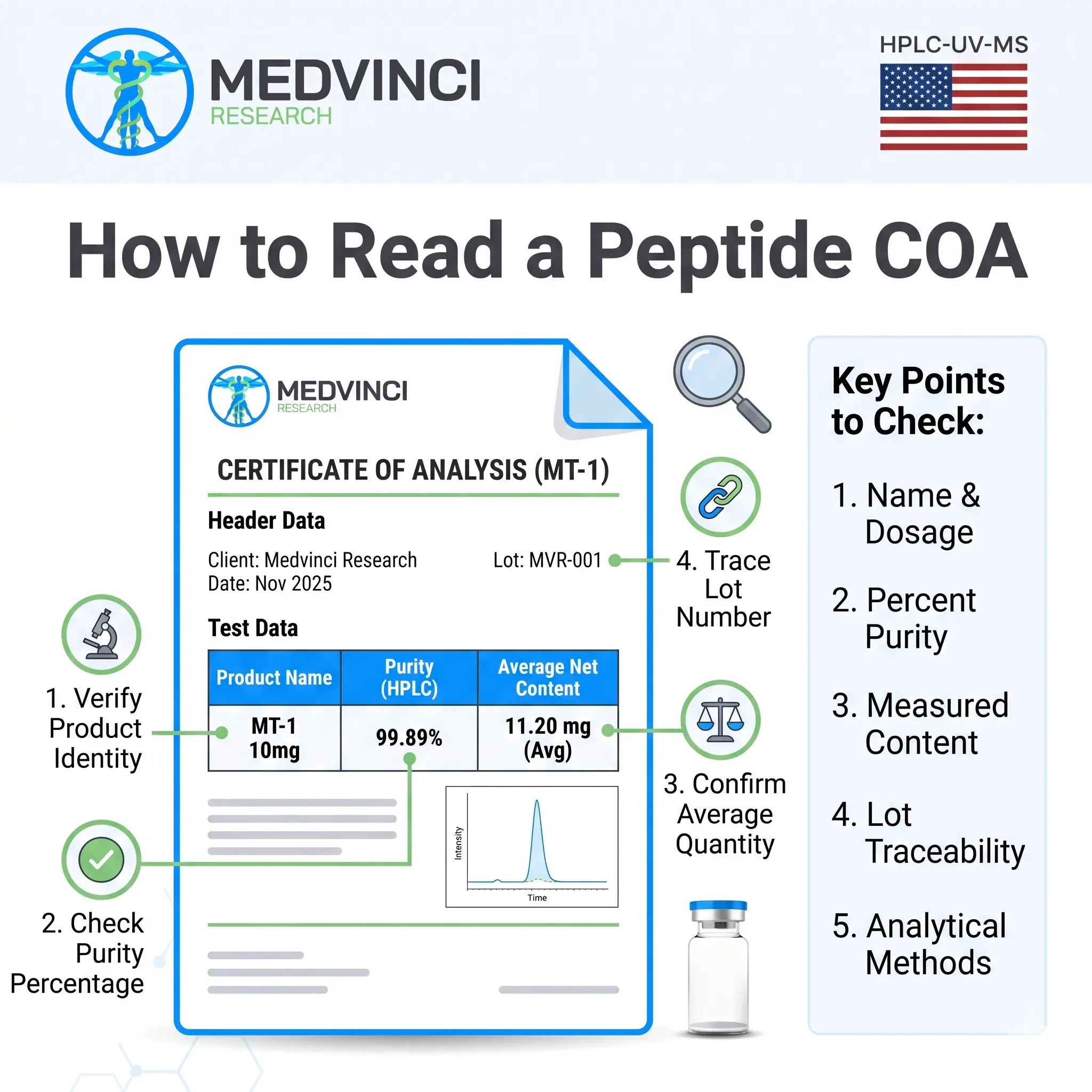
How-to read a Peptide COA | Medvinci Research COAs

A peptide COA is the fastest way to tell whether a peptide batch is backed by real batch-specific analysis or just marketing language. If you know what to match and where to click, you can use a peptide COA to confirm identity, purity, composition, and third-party verification before you trust a number.

Quick rule

Never stop at a purity badge. First confirm the peptide name, the accession code, and the third-party verification page. The purity and composition numbers only mean something after those three things line up.

What a peptide COA actually tells you

A peptide COA is a batch-specific lab record. On a strong report, you should be able to identify the peptide, the batch or accession number tied to that peptide, the method used to analyze it, and the result the lab reported.

That matters because a peptide is only as trustworthy as the batch data behind it. A generic screenshot, a cropped purity number, or an unlabeled report is not the same thing as a verifiable peptide COA.

How Medvinci’s peptide COA page works

Medvinci keeps its COAs on the public COAs page. Each card shows the peptide name, a COA number, and a purity badge. The key action is the Verify COA button, which opens the matching third-party record at Freedom Diagnostics.

That setup gives you two checkpoints instead of one: the Medvinci listing and the outside verification page. If both match, you are looking at the right peptide COA. If they do not, stop there and resolve the mismatch before trusting the batch.

Match the peptide product name and accession code first

Your first job is not reading every lab term. Your first job is making sure the report belongs to the exact peptide you are reviewing.

What to match before you trust the report

  • The peptide name on the COA card should match the product you intended to verify.
  • The COA number or accession code should match the record you open through the verification flow.
  • The outside verification page should point to the same batch-specific entry, not a generic landing page.
  • If the product is a blend or kit, make sure the naming format still matches what Medvinci shows on-site.

Read the method line before the peptide purity number

The Medvinci COA page explicitly tells you the reports are independently verified by Freedom Diagnostics via HPLC-MS/MS. That method line matters because it tells you what kind of analysis produced the peptide result you are about to rely on.

In plain English: you want the report to show that an actual analytical method was used to identify and evaluate the batch. A big peptide purity number with no clear method is weaker than a slightly lower number backed by a traceable method and a real third-party report.

A high purity number is not the first checkpoint. Identity, batch match, and third-party verification come first.

What peptide COA purity and composition mean

The purity number tells you how much of the analyzed sample matched the target peptide under the stated method. Composition tells you what the report is describing and helps confirm you are looking at the right material. Both are useful, but neither is magic. A number like 99.8% is only meaningful if it belongs to the correct peptide and the correct batch.

That is why the order of operations matters. First confirm the report is the right one. Then read the reported purity and composition details. On the Medvinci COA page, that usually means using the on-site peptide card as your index and the third-party page as your confirmation.

Common mistake

Do not treat purity as a substitute for verification. A polished screenshot with a strong number is still weak evidence if you cannot tie it back to the exact peptide and the exact outside report.

Verify the peptide COA through Freedom Diagnostics

This is the part many shoppers skip. On Medvinci, the safest move is clicking the Verify COA button on the product card instead of trying to guess the external lookup manually. That keeps you tied to the exact verification route Medvinci published for that batch.

Once the outside page opens, confirm you are still looking at the same peptide and the same code. If anything looks off, such as a different name, a broken search result, or a page that does not correspond to the Medvinci card, treat that as a red flag until it is resolved.

Common peptide COA red flags

  • The peptide name on the COA does not match the item you are reviewing.
  • The accession number or COA number changes between the Medvinci page and the outside verification page.
  • You only see a screenshot or cropped image instead of a live verification path.
  • The lab method is unclear, missing, or disconnected from the result being advertised.
  • The seller pushes the purity number hard but makes the underlying report difficult to verify.

A simple peptide COA workflow

  1. Open the COAs page and search for the peptide name.
  2. Match the displayed COA number or accession number to the product card.
  3. Click Verify COA and confirm the outside record still matches the same batch.
  4. Only then interpret the purity, composition, and method details.

FAQ about peptide COAs

Do I need to understand every lab term?

No. For most buyers, the high-value move is verifying the peptide match, the accession code, the outside report, and the reported purity. You do not need to become an analytical chemist to spot an obvious mismatch.

Is the highest purity number always the best sign?

Not by itself. A strong number on the wrong report is useless. A slightly lower number on a clearly matched, third-party verified peptide COA is the more credible signal.

Why use the Medvinci verify flow instead of searching the outside lab site blindly?

Because Medvinci already exposes the exact verification path on each COA card. Using that path reduces the chance that you open the wrong record or misread a similar code.

Want to practice on a real report?

Open the live COA directory, choose a peptide, and walk through the match-check-verify sequence yourself. That habit will tell you more than staring at a purity badge in isolation.