
How to Read a Peptide COA
Learn how to read a peptide COA, match accession numbers, verify the batch through Freedom Diagnostics, and interpret purity, composition, and HPLC-MS/MS method lines.
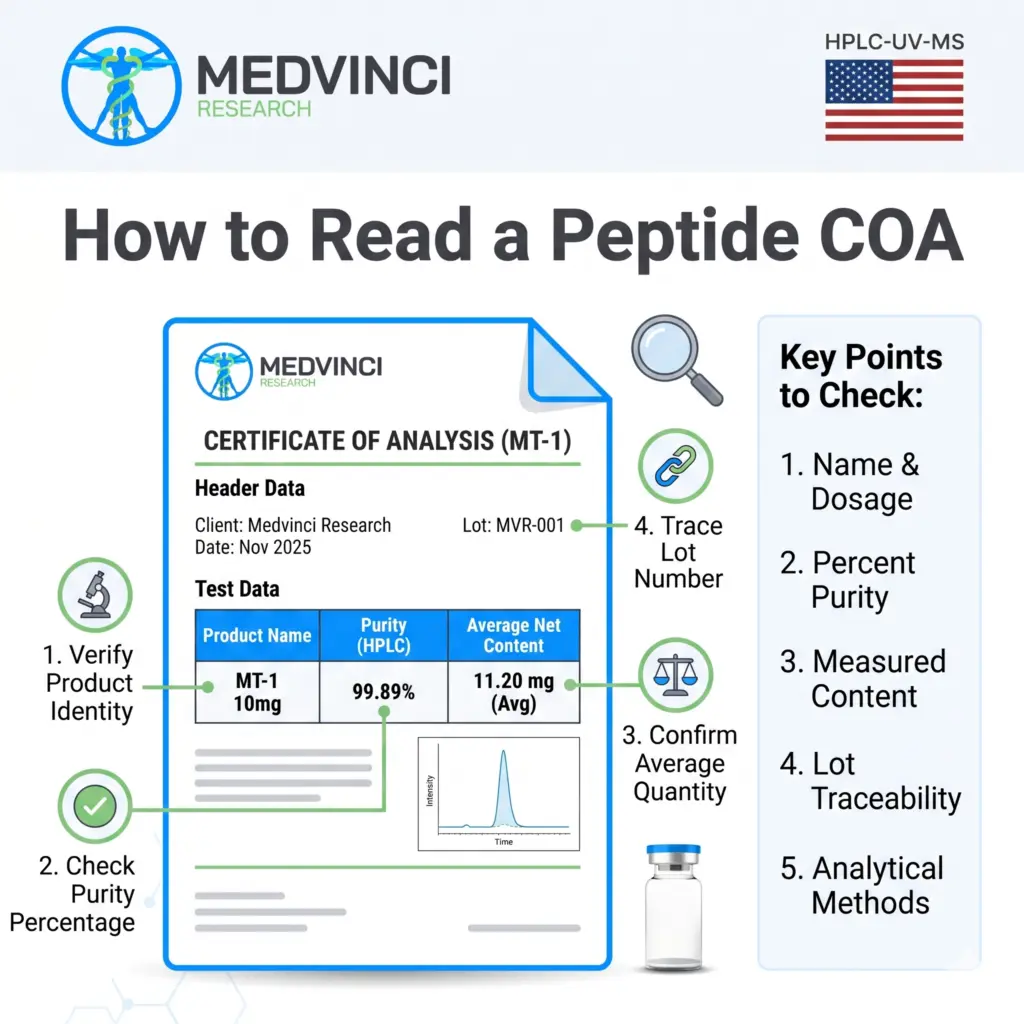
A peptide COA is the fastest way to tell whether a peptide batch is backed by real batch-specific analysis or just marketing language. If you know what to match and where to click, you can use a peptide COA to confirm identity, purity, composition, and third-party verification before you trust a number.
Quick rule
Never stop at a purity badge. First confirm the peptide name, the accession code, and the third-party verification page. The purity and composition numbers only mean something after those three things line up.
What a peptide COA actually tells you
A peptide COA is a batch-specific lab record. On a strong report, you should be able to identify the peptide, the batch or accession number tied to that peptide, the method used to analyze it, and the result the lab reported.
That matters because a peptide is only as trustworthy as the batch data behind it. A generic screenshot, a cropped purity number, or an unlabeled report is not the same thing as a verifiable peptide COA.
How Medvinci’s peptide COA page works
Medvinci keeps its COAs on the public COAs page. Each card shows the peptide name, a COA number, and a purity badge. The key action is the Verify COA button, which opens the matching third-party record at Freedom Diagnostics.
That setup gives you two checkpoints instead of one: the Medvinci listing and the outside verification page. If both match, you are looking at the right peptide COA. If they do not, stop there and resolve the mismatch before trusting the batch.
Match the peptide product name and accession code first
Your first job is not reading every lab term. Your first job is making sure the report belongs to the exact peptide you are reviewing.
What to match before you trust the report
- The peptide name on the COA card should match the product you intended to verify.
- The COA number or accession code should match the record you open through the verification flow.
- The outside verification page should point to the same batch-specific entry, not a generic landing page.
- If the product is a blend or kit, make sure the naming format still matches what Medvinci shows on-site.
Read the method line before the peptide purity number
The Medvinci COA page explicitly tells you the reports are independently verified by Freedom Diagnostics via HPLC-MS/MS. That method line matters because it tells you what kind of analysis produced the peptide result you are about to rely on.
In plain English: you want the report to show that an actual analytical method was used to identify and evaluate the batch. A big peptide purity number with no clear method is weaker than a slightly lower number backed by a traceable method and a real third-party report.
A high purity number is not the first checkpoint. Identity, batch match, and third-party verification come first.
What peptide COA purity and composition mean
The purity number tells you how much of the analyzed sample matched the target peptide under the stated method. Composition tells you what the report is describing and helps confirm you are looking at the right material. Both are useful, but neither is magic. A number like 99.8% is only meaningful if it belongs to the correct peptide and the correct batch.
That is why the order of operations matters. First confirm the report is the right one. Then read the reported purity and composition details. On the Medvinci COA page, that usually means using the on-site peptide card as your index and the third-party page as your confirmation.
Common mistake
Do not treat purity as a substitute for verification. A polished screenshot with a strong number is still weak evidence if you cannot tie it back to the exact peptide and the exact outside report.
Verify the peptide COA through Freedom Diagnostics
This is the part many shoppers skip. On Medvinci, the safest move is clicking the Verify COA button on the product card instead of trying to guess the external lookup manually. That keeps you tied to the exact verification route Medvinci published for that batch.
Once the outside page opens, confirm you are still looking at the same peptide and the same code. If anything looks off, such as a different name, a broken search result, or a page that does not correspond to the Medvinci card, treat that as a red flag until it is resolved.
Common peptide COA red flags
- The peptide name on the COA does not match the item you are reviewing.
- The accession number or COA number changes between the Medvinci page and the outside verification page.
- You only see a screenshot or cropped image instead of a live verification path.
- The lab method is unclear, missing, or disconnected from the result being advertised.
- The seller pushes the purity number hard but makes the underlying report difficult to verify.
A simple peptide COA workflow
- Open the COAs page and search for the peptide name.
- Match the displayed COA number or accession number to the product card.
- Click Verify COA and confirm the outside record still matches the same batch.
- Only then interpret the purity, composition, and method details.
FAQ about peptide COAs
Do I need to understand every lab term?
No. For most buyers, the high-value move is verifying the peptide match, the accession code, the outside report, and the reported purity. You do not need to become an analytical chemist to spot an obvious mismatch.
Is the highest purity number always the best sign?
Not by itself. A strong number on the wrong report is useless. A slightly lower number on a clearly matched, third-party verified peptide COA is the more credible signal.
Why use the Medvinci verify flow instead of searching the outside lab site blindly?
Because Medvinci already exposes the exact verification path on each COA card. Using that path reduces the chance that you open the wrong record or misread a similar code.
Want to practice on a real report?
Open the live COA directory, choose a peptide, and walk through the match-check-verify sequence yourself. That habit will tell you more than staring at a purity badge in isolation.
Use the COA directory like a double-check, not a decoration.
Search the product, match the accession number, then open the Freedom Diagnostics verification page directly from Medvinci’s COA hub.