
Peptide COA Verification: Third-Party vs. Vendor-Only COAs
Learn how peptide COA verification works, what purity, quality, and composition claims actually mean, and how to tell a third-party COA from a vendor-only report.
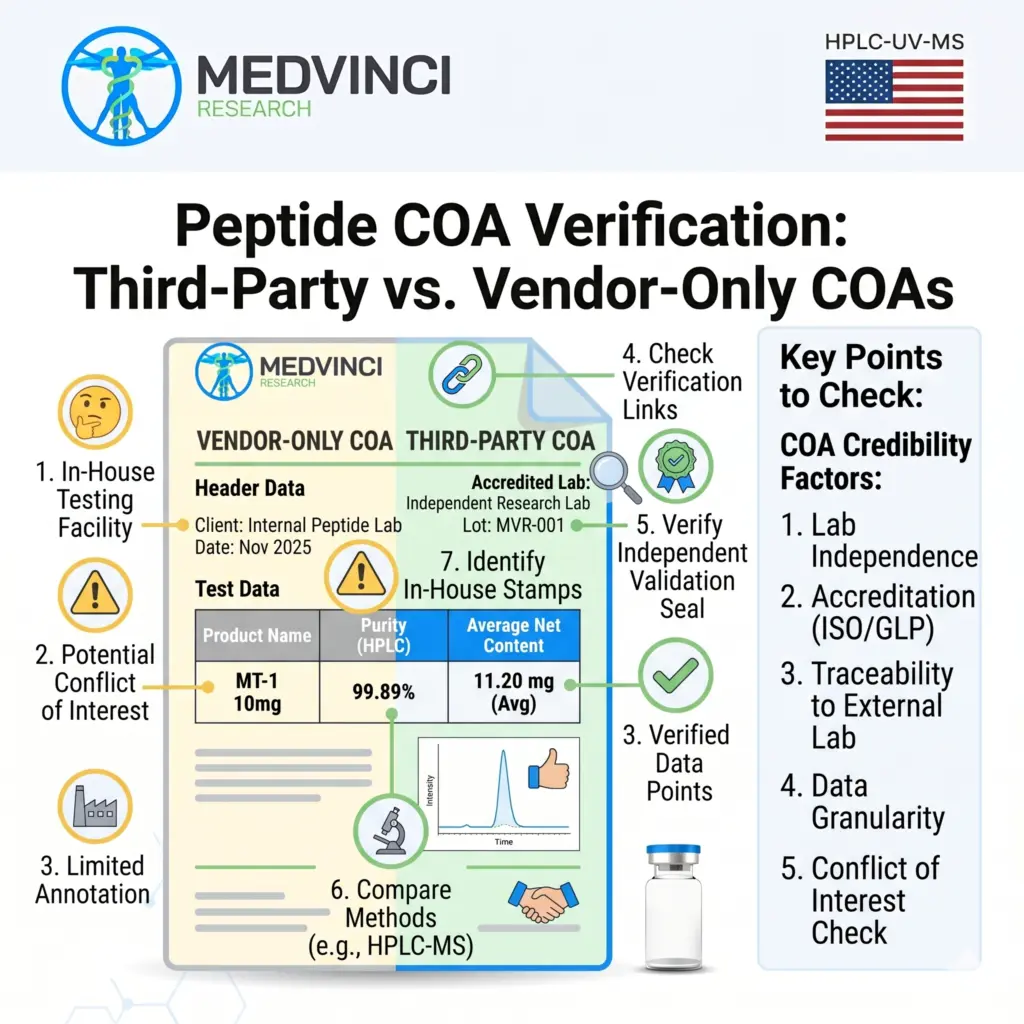
Peptide COA verification is the difference between seeing a purity claim and confirming that the batch behind it is real. The critical question is not whether a seller says a COA exists, but whether you can match the peptide, the accession code, and the outside verification path without relying on a single site.
Fast takeaway
A vendor-only peptide COA can still be useful, but it asks you to trust a single party. A third-party verified peptide COA adds an outside checkpoint, which makes it much harder for the proof chain to break without you noticing.
What peptide COA verification actually means
Peptide COA verification means confirming that the peptide listing, the batch record, and the outside proof chain all point to the same thing. It is not just reading a PDF. It is making sure the peptide, the accession code, and the verification route line up before you trust the result.
That matters because a buyer can be shown a real-looking report that still does not belong to the exact peptide they are considering. Verification is what turns a seller claim into something you can test.
What a vendor-only peptide COA is
A vendor-only peptide COA is a report the seller provides directly, usually as a PDF, image, or embedded document on the product page. That does not automatically mean the report is bad. It means the same business selling the peptide is also controlling the evidence you are being asked to trust.
That setup creates a simple problem: if the report is cropped, outdated, generic, hard to match to a batch, or impossible to verify outside the seller’s site, you have no second checkpoint. You are left evaluating a claim inside the same system that benefits from the sale.
What third-party peptide COA verification adds
Third-party peptide COA verification adds an outside record. Instead of stopping at a seller-hosted document, you can compare the on-site listing to a separate verification page and make sure the peptide name, accession code, and report path still line up.
That extra step matters because it changes the trust model. You are no longer relying on one business to say both this is the batch and trust us, the report is real. You can check the batch against an independent source before you rely on the purity claim.
| Checkpoint | Vendor-only COA | Third-party verified COA |
|---|---|---|
| Where the proof starts | On the seller’s site | On the seller’s site plus an outside verification record |
| Who controls what you can see | The seller controls the full proof chain | The seller publishes the route, but you can verify beyond the seller page |
| Batch matching confidence | Often weaker if the document is generic or hard to trace | Stronger when the accession code and outside record match |
| Best use | Starting point for questions | Stronger basis for trust before ordering |
How peptide purity, quality, and composition fit into the picture
Peptide purity, quality, and composition are important, but they only matter after you know the report belongs to the right batch. Purity tells you how much of the analyzed sample matched the target peptide. Composition helps confirm what the sample contains. Quality is the broader trust question that includes the method, the report path, and whether the batch can be verified beyond the seller page.
That is why verification comes first. If the proof chain is weak, a strong-looking purity number can still mislead the buyer. Verification makes those downstream metrics worth reading.
Do not ask only, “Is there a COA?” Ask, “Can I verify this peptide batch outside the seller’s own page?”
How to verify a Medvinci peptide COA
Medvinci keeps its COAs on the public COA directory. Each listing gives you a peptide name, a COA number, a purity result, and a Verify COA action that points you to the corresponding Freedom Diagnostics verification page.
That matters because the Medvinci card is not meant to be the end of the process. It is the index. The outside verification page is the confirmation step. When the peptide and code match across both, you have a much stronger reason to trust the batch record than you would from a seller-hosted PDF alone.
A fast peptide COA trust test
- Find the product on the COA directory.
- Match the peptide name and displayed COA number.
- Click Verify COA and confirm the Freedom Diagnostics page corresponds to the same batch.
- Only after that, interpret the purity, quality, composition, and method details.
Red flags in peptide COA verification
- The seller shows a report image, but there is no live verification path.
- The peptide name and batch code are hard to match across pages.
- The report looks polished, but the underlying source is unclear or inaccessible.
- The purity number is emphasized more than the batch identity or verification route.
- The outside record does not line up cleanly with the peptide you intended to buy.
Vendor-only does not always mean bad, but it does mean weaker proof
This distinction is worth making clearly. A vendor-only peptide COA is not automatically fake or worthless. It is just easier to trust too quickly because the whole story lives inside the seller’s own presentation layer. If the proof cannot be independently checked, you should treat it as weaker evidence.
Third-party verified peptide COAs are stronger because they reduce how much blind trust is required. That is the real advantage: not marketing language, but a cleaner chain of verification.
FAQ
Is a vendor-only COA automatically a dealbreaker?
No. It is a signal to slow down and ask for a clearer proof chain. The issue is not that every vendor-only report is false. The issue is that you have fewer independent ways to confirm it.
Is third-party verification enough on its own?
It is stronger, but you still need to make sure you are looking at the correct peptide and the correct batch. Verification only helps if the match is clean.
What is the safest way to verify a Medvinci peptide COA?
Start from the COA directory, use the on-site card to identify the peptide and code, then click Verify COA so you land on the matching Freedom Diagnostics page. If you want a deeper walkthrough of reading the report itself, see How to Read a Peptide COA.
Compare a live example yourself
Open the COA directory, choose a peptide, and compare the Medvinci listing to the outside verification page. That one habit will tell you more than any isolated purity badge.
Use the COA directory like a double-check, not a decoration.
Search the product, match the accession number, then open the Freedom Diagnostics verification page directly from Medvinci’s COA hub.